Guides · History & Culture
The Free Speech Movement and 1960s Berkeley
How Berkeley students ignited a revolution in student rights and political expression at the university.

Advertisement
The Spark: October 1, 1964
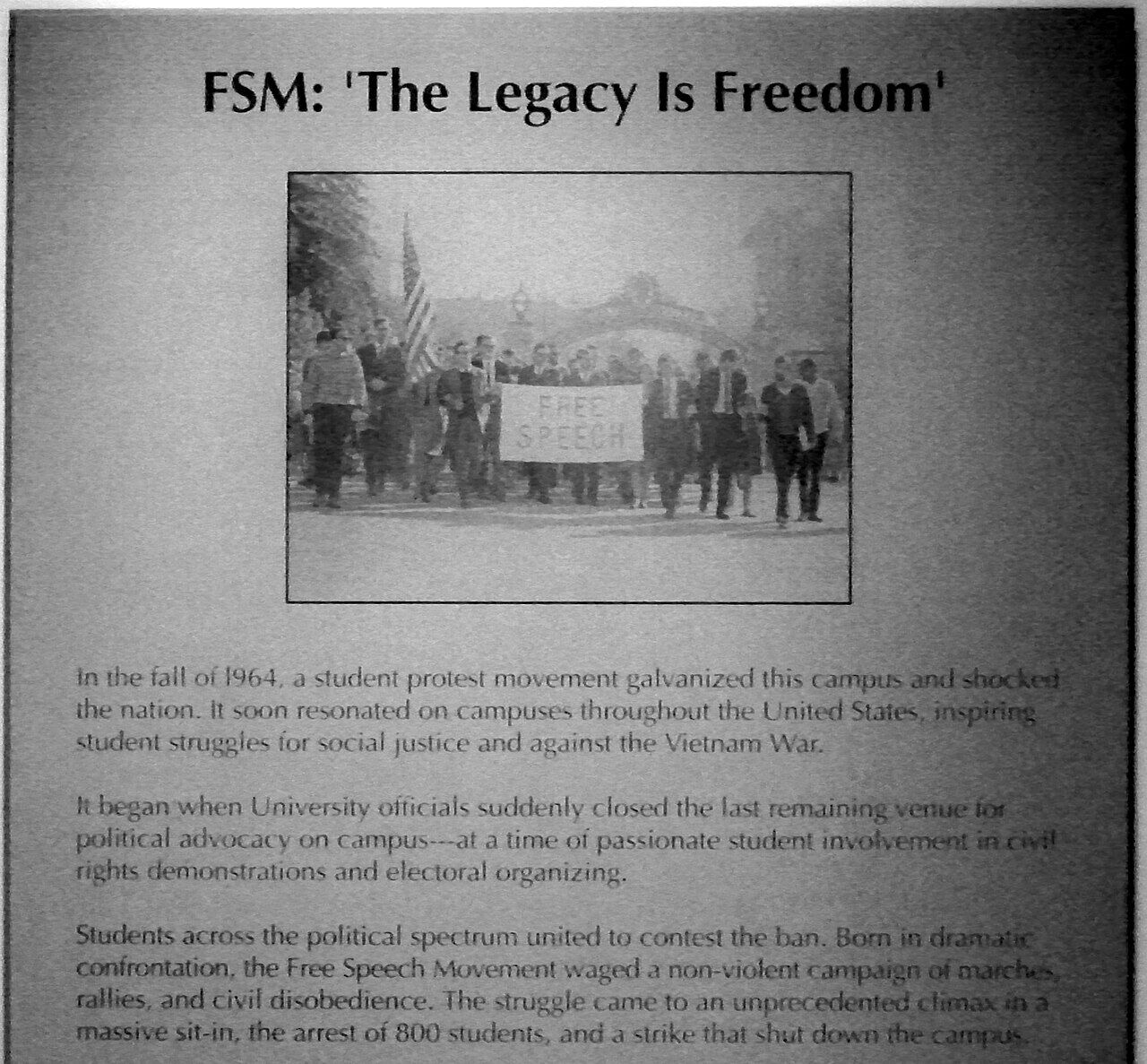
On October 1, 1964, UC Berkeley became the epicenter of a student uprising that would reshape American higher education and become a defining moment of the 1960s. Mathematics graduate student Jack Weinberg was arrested for setting up a Congress of Racial Equality (CORE) information table in front of Sproul Hall, where student political advocacy had been banned. In response, hundreds of students surrounded the police car holding Weinberg and maintained a 32-hour blockade. Students made speeches from atop the car, negotiated directly with administration, and ultimately secured Weinberg’s release—not through arrest or force, but through collective action.
This singular event catalyzed the Free Speech Movement (FSM), which became one of the most influential student movements in American history. The underlying issue was simple: the university had banned political speech and organizing on campus. But the stakes were profound, touching on fundamental questions about free expression, student rights, and the role of universities in society.
Mario Savio and the Movement
While multiple leaders guided the Free Speech Movement, Mario Savio emerged as its most eloquent and uncompromising voice. Born in New York to an Italian-American family, Savio came to Berkeley as a transfer student in 1963. He initially studied philosophy and found his political awakening through activism—first in efforts to desegregate local Berkeley businesses, then as a participant in the Mississippi Summer Project of 1964, where he worked to register Black voters in the Deep South.
Returning to Berkeley, Savio brought moral clarity to the campus debate. He articulated why students were fighting not just for themselves, but for the principle that universities must remain spaces of free thought and political engagement. His speeches combined passionate moral conviction with logical argument, making him a compelling leader for the growing movement.
December 2: The Turning Point
The movement reached its climax on December 2, 1964, when the university announced disciplinary hearings against movement leaders. Rather than submit to the process, approximately 4,000 students gathered at Sproul Hall. Savio delivered his most famous speech, the “Bodies Upon the Gears” address, speaking from the steps of the building to an enormous crowd. In memorable language, he argued that students must use civil disobedience to stop the administrative machine that sought to regulate their speech.
That night, 800 students marched into Sproul Hall and occupied the building. Police arrested them all in what became the largest mass arrest on a college campus in American history to that point. Many of those arrested were dragged from the building and taken to jail, yet the event strengthened rather than weakened the movement’s moral authority. The images of police carrying away peaceful students shocked the nation and drew sympathy to the FSM cause.
Victory and Impact
The Free Speech Movement’s victory came swiftly. Faculty members, moved by the students’ moral seriousness and concerned about the university’s handling of the crisis, forced university administrators to negotiate. Within weeks, the university revised its policies to permit political speech and organizing on campus. Students won the right to advocate for causes, distribute literature, and organize politically—rights that seem obvious today but were restricted on many campuses in 1964.
But the movement’s impact extended far beyond Berkeley’s campus. The FSM demonstrated that students could challenge institutional authority through sustained, organized, nonviolent action. The model inspired student movements at universities across the country. Student activism became a defining feature of the late 1960s, from civil rights campaigns to anti-war protests to struggles for campus reform.
The Broader 1960s Movement
The Free Speech Movement set the stage for Berkeley’s role as a center of 1960s activism more broadly. In May 1969, students and community members occupied People’s Park, a vacant university lot, to create a community green space. The resulting confrontation between students and police—with the famous words “the police aren’t here to create disorder, they’re here to preserve disorder”—became another iconic moment in Berkeley’s activist history.
Simultaneously, Berkeley became home to the Black Panther Party, founded in Oakland by Bobby Seale and Huey Newton. The party’s emphasis on Black self-determination and armed self-defense profoundly influenced black consciousness and activism across the country. Though often portrayed as violent, the Panthers also provided community services—breakfasts for children, health clinics, and educational programs—that reflected their revolutionary vision of community care.
Walking the Free Speech Movement Sites
Today, visitors to Berkeley can walk through the geography of the Free Speech Movement:
Sproul Hall remains the administrative center of UC Berkeley. The plaza in front—where thousands gathered to hear Savio speak—is now Sproul Plaza, often filled with students, performers, and activists. Inside, plaques commemorate the movement.
Telegraph Avenue, the main street bordering the campus, became synonymous with student culture and activism. The famous mural on the wall of Amoeba Music (2455 Telegraph Ave) depicts scenes from the Free Speech Movement and later activist moments, including anti-war protests, the Black Panthers, and People’s Park.
People’s Park (2556 Haste St) marks the location of the 1969 occupation. A small community garden now marks the spot, though its history remains contested. Visitors can reflect on how the park represents ongoing tensions between community needs and institutional control.
The Berkeley Public Library (2090 Kittredge St) contains archives and exhibits related to Berkeley’s activist history, including materials on the Free Speech Movement.
Legacy and Lessons
Over six decades later, the Free Speech Movement remains relevant and studied. It raised enduring questions: How should universities balance student rights with institutional order? What are the limits of legitimate institutional authority? How does social change happen?
The movement succeeded because it combined moral clarity with practical organizing. It grounded its claims in education and free inquiry—the core mission of universities. And it demonstrated that students, when organized and committed, possessed significant power to change institutions.
For many visitors to Berkeley, the sites of the Free Speech Movement offer a chance to reflect on how a group of young people challenged authority in the name of principle and changed not just their university, but the broader culture. Whether viewed as a triumph of student empowerment or a cautionary tale of campus disruption often depends on perspective—but its historical significance is undeniable.
Advertisement
More History & Culture
A Short History of Berkeley
From Ohlone territory to university town: how Berkeley became California's cultural capital.
Berkeley Music History
From folk music venues to punk rock clubs to a legendary recording label—Berkeley's vibrant music culture.
Berkeley's Architecture: Maybeck, Julia Morgan, and Arts & Crafts
How visionary architects shaped Berkeley's distinctive built environment and influenced American design.